Equity vs. salary: what you're really trading
A startup offers you less cash and more stock. Is that a lottery ticket or a real stake?
Updated 6 min read
Choosing equity vs. salary means trading certain cash today for a small, uncertain share of a future sale. Salary pays your bills. Equity only pays if the company succeeds, you stay long enough to vest, and dilution leaves you a meaningful slice. Take equity you can afford to lose.
Should you take equity or salary?
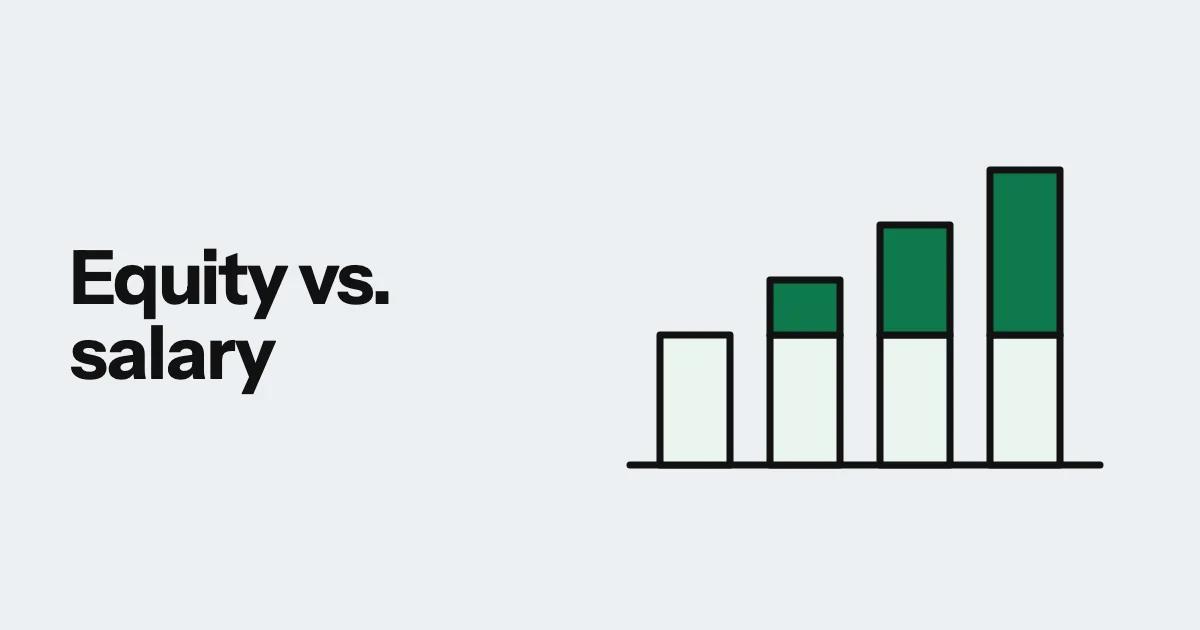
Take the salary you need to live well, and treat equity as upside. That one rule prevents most bad decisions.
Here's why. Remember the three ways to make a million dollars: save it, earn it as profit, or sell something you own. A salary is the first equation. Equity is a small ticket into the third. Our breakdown of the math of a million dollars shows why owners get there first. Employee equity lets you own a sliver.
Paul Graham argued that getting rich needs measurement and leverage. A big company salary rarely has either. A startup stake has both, at the cost of a lot more risk.
How does startup equity actually work?
Five terms decide what your equity is worth. Learn them before you negotiate.
| Term | Plain meaning |
|---|---|
| Stock option | The right to buy shares later at a fixed price |
| Strike price | That fixed price. You pay it when you exercise (buy) |
| Vesting | You earn your options over time, often four years |
| Cliff | Nothing vests until a date, often one year in |
| Exercise window | How long you have to buy vested options after you leave |
A common schedule is four years with a one-year cliff. Leave at month 11 and you get nothing. At month 12, a quarter vests at once. After that, the rest usually vests monthly.
What is your startup equity really worth?
Use a simple formula, then be honest about the inputs.
Value ≈ your percent of the company × the price it sells for × the chance it gets there.
A made-up example to show the mechanics: you own 0.5% of a company that later sells for $200 million. On paper that's $1 million. Then reality takes its cut.
- Dilution: each new funding round issues new shares, so your percent shrinks.
- Liquidation preferences: investors are often paid back first in a sale, before common stock like yours.
- Strike price and taxes: you pay to buy the shares, and taxes can apply.
- Odds: most startups never reach a large sale. Many shut down and the options are worth nothing.
None of this means equity is bad. It means a number on an offer letter is a maximum, not an amount.
When has taking equity paid off?
The famous case is David Choe. In 2005 he painted murals in Facebook's early office and chose stock instead of cash for the job. By the time Facebook went public in 2012, that stake was widely reported to be worth hundreds of millions of dollars.
Early employees at companies like Google and Facebook also became wealthy through stock. Those stories are real. They are also the most-told outcomes from thousands of startups, which is survivorship bias again. For every Choe, many people took a pay cut for options that expired worthless.
How do you compare two job offers with equity?
Put both on one table. These offers are hypothetical, built to show the method.
| Offer A: big company | Offer B: startup | |
|---|---|---|
| Salary | $150,000 | $120,000 |
| Equity | Public stock, sellable when it vests | 0.25% in options, not sellable until a sale or IPO |
| Four-year cash gap | — | −$120,000 |
| Breaks even if… | — | The company sells for well over $48M after dilution |
The math: 0.25% of $48 million is $120,000, exactly the cash you gave up. And that's before dilution, preferences, the strike price and taxes. So the real break-even is much higher. If the gap would strain your finances, Offer B is a bad bet for you no matter how exciting it is.
What should you ask before you sign?
- How many shares are outstanding, fully diluted? (So you can work out your percent.)
- What is the strike price, and the latest valuation for options (often called a 409A)?
- What's the vesting schedule and cliff?
- How long is the exercise window if I leave?
- How much money has the company raised, and with what liquidation preferences?
- Can I trade some salary for more equity, or the reverse?
A good company answers these plainly. If they won't, that tells you something too. Owning a business outright skips these questions, which is part of why boring businesses appeal to so many owners.
Use it this week
- Write down the salary you need to live comfortably and save. Never go below it for equity.
- If you hold options now, find your share count, strike price and exercise window.
- Run the formula on your stake: percent owned × a realistic sale price, then halve it.
- Send the six questions above to any startup that makes you an offer.
Get the next essay in your inbox
One essay on building wealth through ownership and leverage, plus one thing to try that week. Free.
Frequently asked questions
Is startup equity worth it?
Sometimes. It can be worth a lot if the company sells well and you stay to vest. Most startups don't reach that point, so value equity as a bonus and take a salary you can live on.
What is a one-year cliff?
It means none of your options vest until you've worked one full year. On that date a chunk, often 25% on a four-year schedule, vests at once. Leave before it and you usually keep nothing.
What happens to my stock options if I leave?
Unvested options usually go back to the company. Vested options must often be bought within a set window, commonly around 90 days, or they expire. Check your option agreement for your exact terms.
How much equity should an early employee get?
It varies widely by stage, role and location, so ignore anyone quoting one number. Ask for your percent of fully diluted shares and compare it against the salary you're giving up.
Sources
- David Choe (Wikipedia)
- Paul Graham, How to Make Wealth (2004)
- Stock option basics, US SEC Investor.gov
This essay is general education, not financial, legal or tax advice. Examples describe public, documented stories and are not promises of any result.